


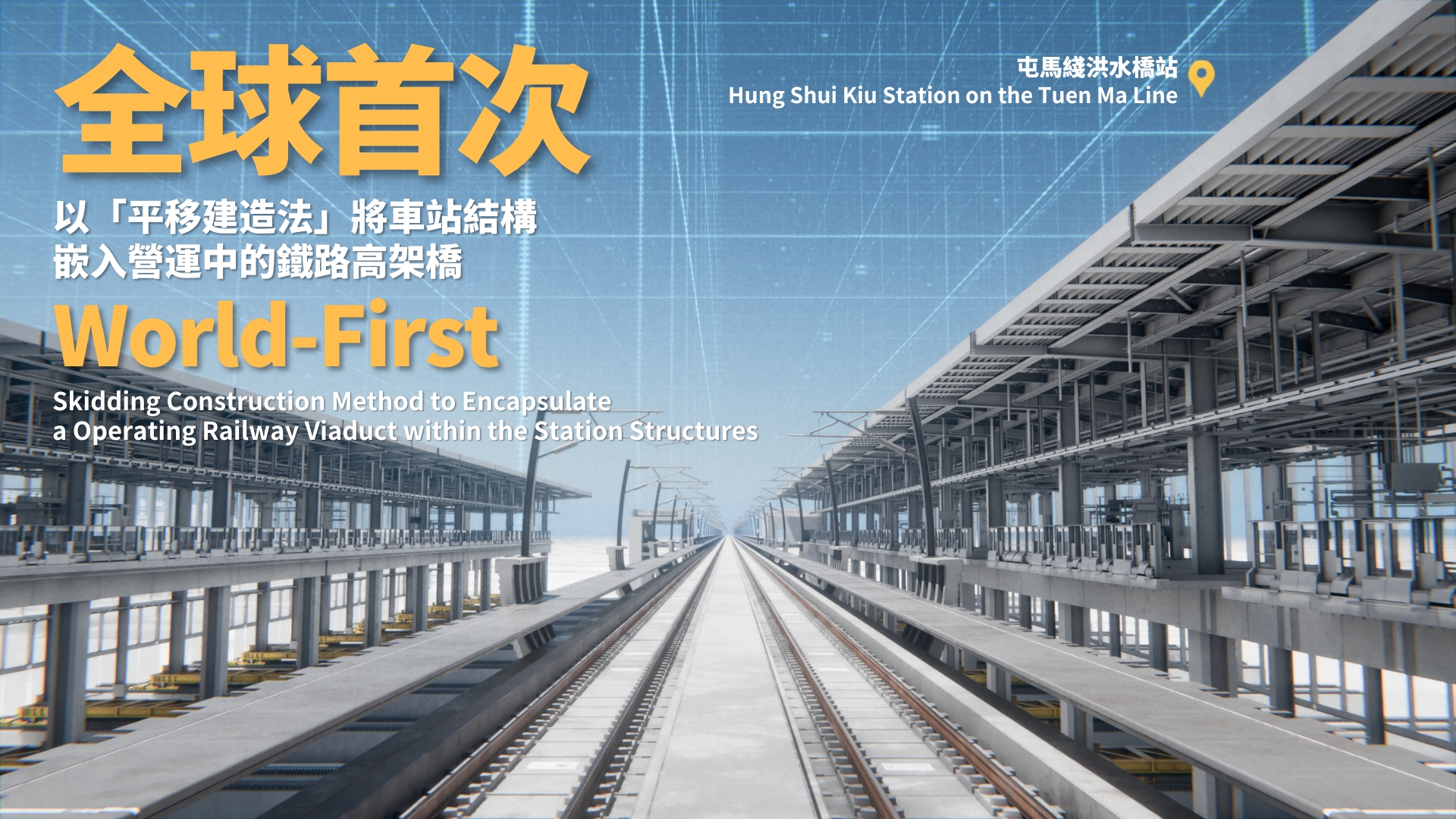
Hung Shui Kiu Station’s Geographical Location Presents Unique Construction Challenges
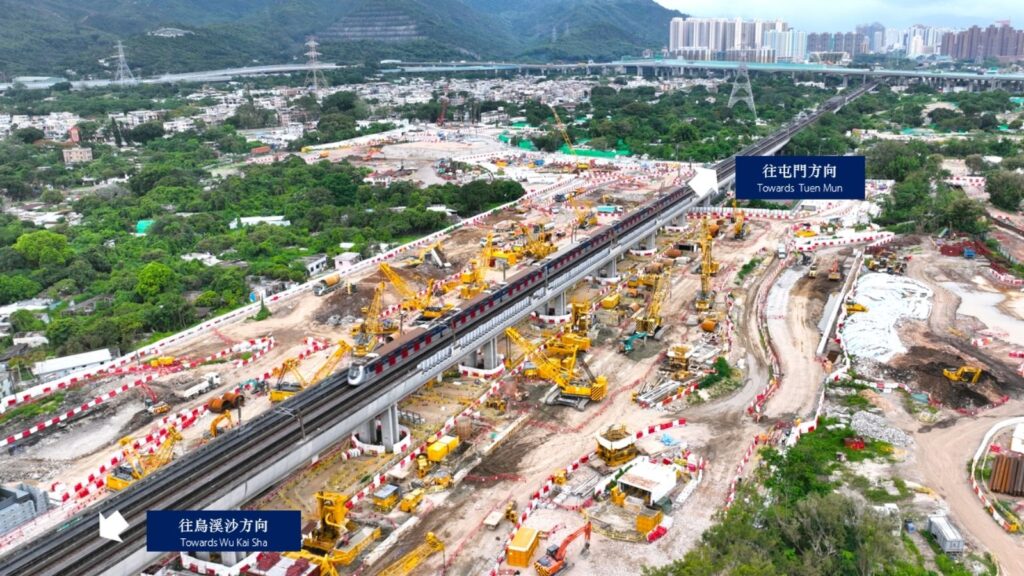
Hung Shui Kiu Station (HSK Station) is located between Tin Shui Wai Station and Siu Hong Station on the existing Tuen Ma Line. The two-level station, comprising a ground-level concourse and upper-level platforms, will be constructed on both sides of the existing Tuen Ma Line viaduct. It will be the first station in Hong Kong to be constructed on an operating railway viaduct.
Constructing a new station by “inserting” it between two existing stations on an operating railway line presents significantly greater and more complex challenges than building a new station along a new line extension. For example, when extending an existing railway line, construction is typically carried out from the end of the operating line. Construction of new stations along the extension can be carried out on a site that is physically separated from the operating railway (a greenfield environment), before connecting with the operating line during the final stages of the project. Examples include the West Island Line extension (Sai Ying Pun Station – Kennedy Town Station) and the South Island Line (Ocean Park Station – South Horizons Station).
In contrast, the HSK Station construction site is located on both sides of an existing railway viaduct (a brownfield environment). Under a conventional construction approach, construction materials and structural components would need to be lifted sequentially by large cranes from ground level to the viaduct level for assembly. Upon completion of the civil structures, mechanical & electrical (E&M), and other railway systems and equipment would then be installed and connected within the station structure. This means that major lifting and construction activities would have to be carried out in close proximity to the operating Tuen Ma Line, potentially posing risks to railway operations, construction safety, and construction time:
- Railway Service and Operations – With railway safety as the top priority, it is not feasible to undertake large-scale lifting operations and station construction works adjacent to the viaduct while trains are in service. Such works can only be carried out during the “Golden Two Hours” work window after train services end each night.
- Construction Safety Risks – Following each night’s work within the “Golden Two Hours” work window, thorough inspections must be conducted to ensure train services can be resumed on the following day. Frequent construction activities on or near the railway also increase the risks and maintenance requirements associated with operating a live railway.
- Limited Working Hours – In addition to being restricted to the “Golden Two Hours” work window, the Tuen Ma Line must also accommodate routine inspection and maintenance. As a result, only around two to three nights per week are available for Hung Shui Kiu Station construction works, creating a significant constraint on the overall construction programme.
“Build First, Skid Later” An Innovative Solution to Overcome the Geographical Constraints
To address both the time and risk challenges, the project team explored alternative approaches from the earliest design stage. Drawing on examples from major infrastructure projects around the world, the team decided to adopt the skidding construction method for the construction of HSK station.
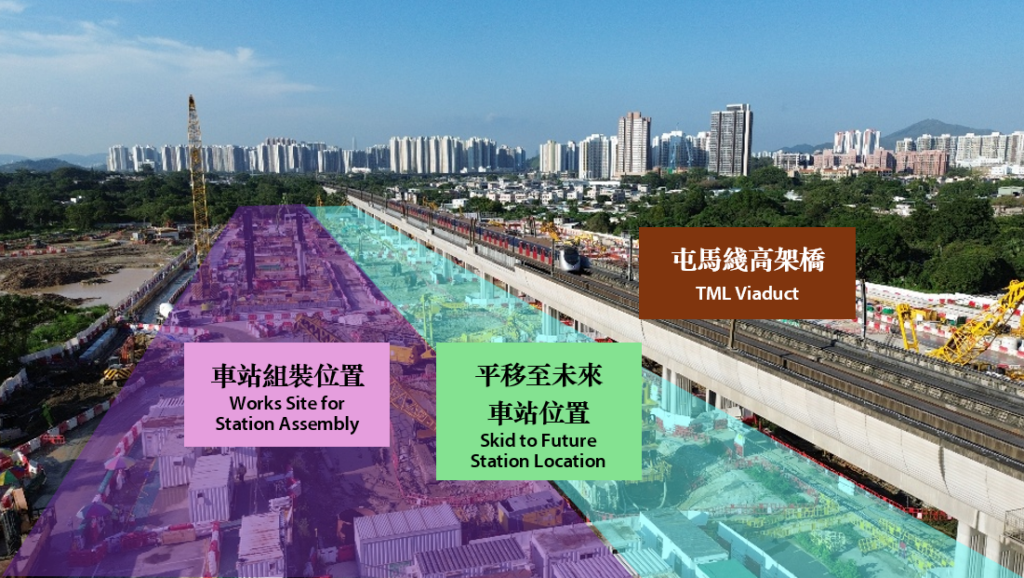
The core concept of the skidding construction method is “Build First, Skid Later”. It involves two steps: 1) Assembly of prefabricated components, and 2) skidding of the massive structure. This breaks through the traditional “in-situ” approach of constructing station structures directly on the railway alignment. Instead, a modular approach is adopted by firstly assembling the station components at a worksite approximately 30 metres away from the existing viaduct, before the assembled components are skidded into their final positions.
To overcome the various site and environmental constraints, the MTR project team adopted innovative thinking and technologies starting from the design stage. By using Design for Manufacture and Assembly (DfMA), supported by Building Information Modelling (BIM), the station can be precisely designed, divided into different prefabricated components and manufactured in off-site factories. These components are then transported to the work site and assembled into massive station structures.
The entire station is made of nearly 4,000 prefabricated components which are assembled into a number of large-scale station modules. The two largest modules form the main station structures at both sides of the viaduct. Each module measures 210 metres in length, 15 metres in width and weighs around 10,000 tons. The assembled structures are substantially complete, encompassing major civil parts, including the ground-level concourse, upper-level platforms and rooftop structure, as well as incorporating major E&M and building services installations through the adoption of Mechanical, Electrical and Plumbing Modular Integrated Construction (MiMEP). Automatic Platform Gates (APGs) are also pre-installed as part of the assembled structures.
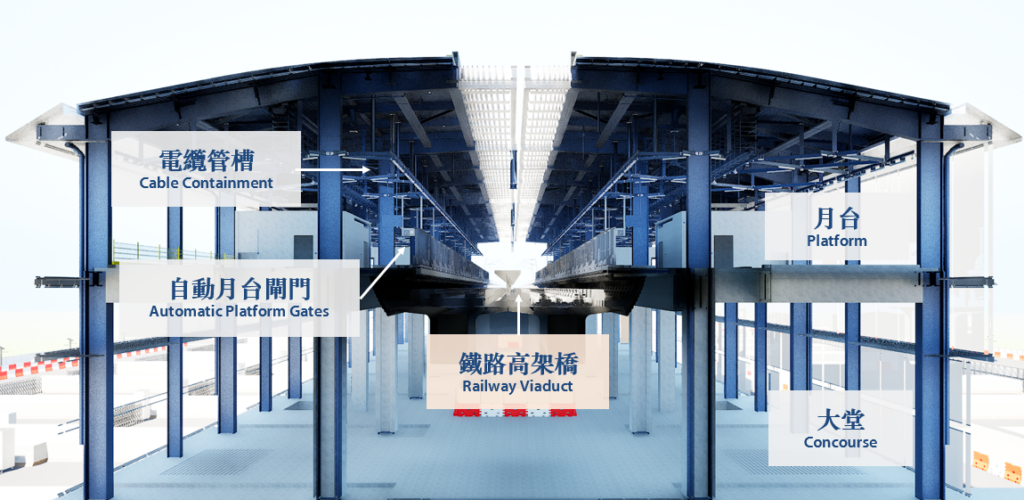
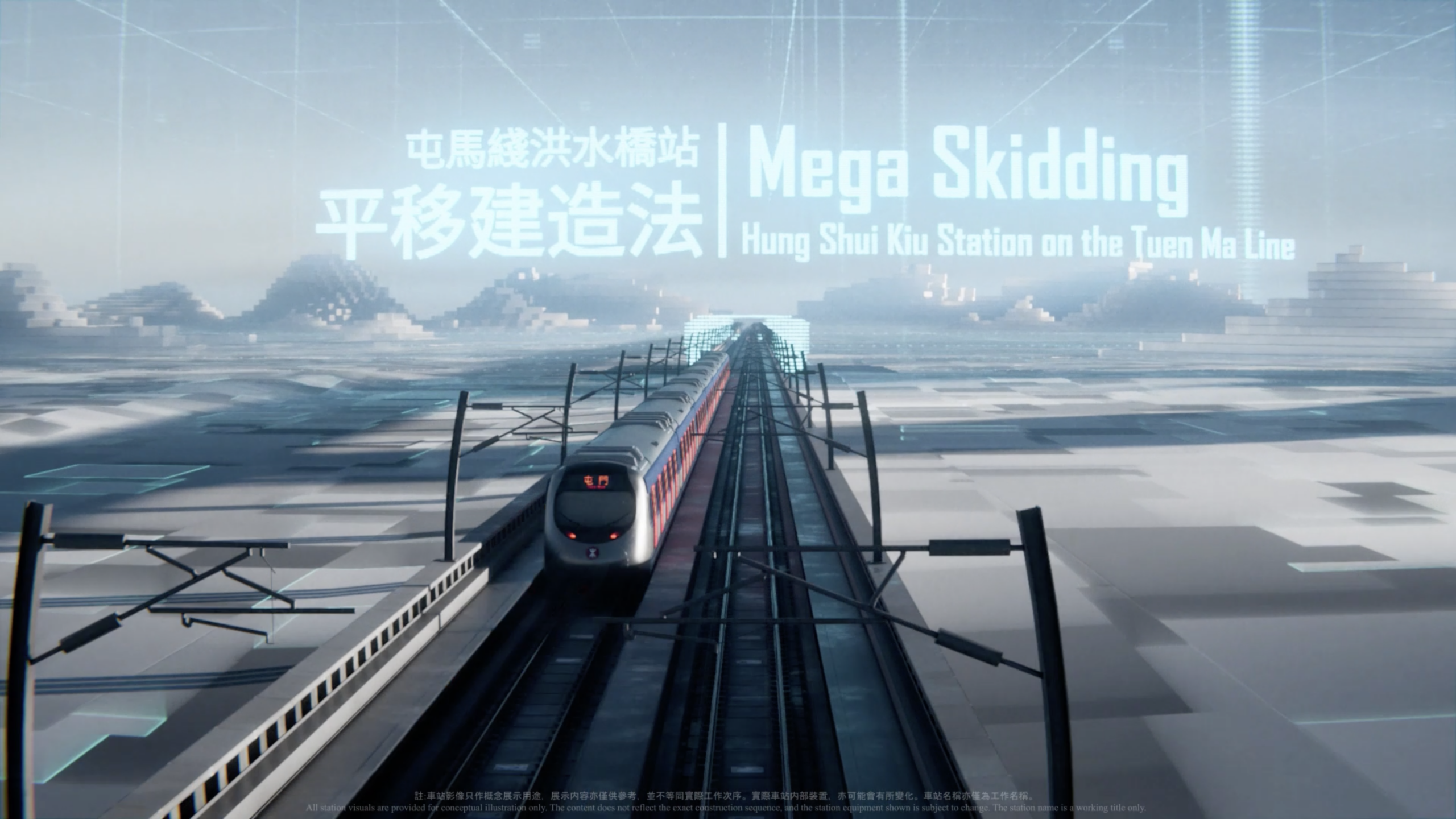
Simulation of the Station Main Structures upon Completion of Assembly
The World’s First Adoption of “Skidding Construction” to Build a Railway Station on an Operating Railway Viaduct
Once the station structures have been assembled, the next challenge is to “move” them into their designated positions on both sides of the existing railway viaduct. The “Skidding Construction” method has been adopted in numerous projects around the world and is proven and well-established. Using a large-scale hydraulic jacking system, the entire structure can be skidded steadily and precisely while maintaining its structural integrity. The structure is then carefully aligned with and secured onto the foundations that have been constructed in advance. The construction of HSK Station will be the world’s first application of this method to enclose and connect a highly competed station structure with an operating railway viaduct, establishing a new benchmark in railway construction.
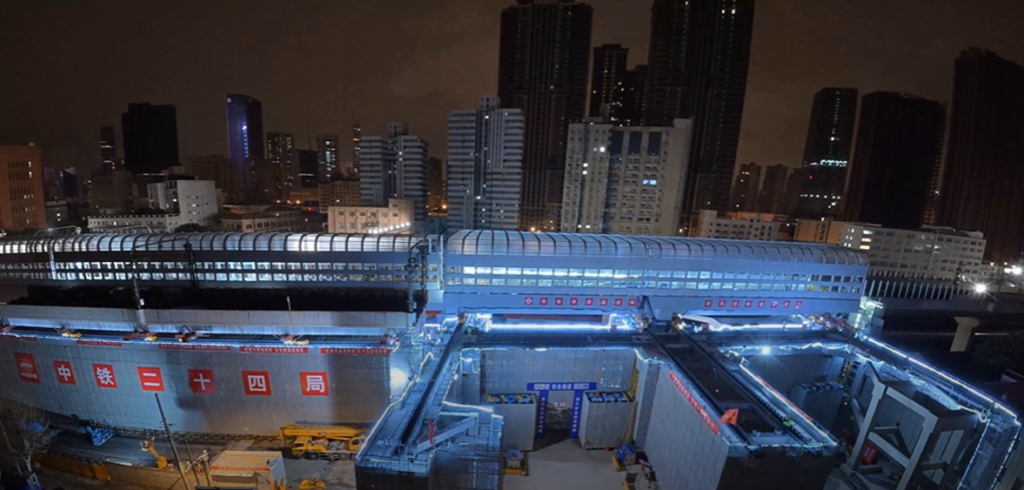
Baoshan Road Station Railway Bridge Skidding and Connection Works in Shanghai (Image source: Screenshot from a station skidding construction video)
Key to Success: Precision in Every Step
The significance of this construction lies in the fact that it is not merely the relocation of a massive structure. It involves the precise movement and installation of two “station-ready” structures, each weighing 10,000 tons and incorporating pre-installed station infrastructure and E&M equipment, such as Automatic Platform Gates (APGs), and the seamless integration of the structures with an existing operating railway system. The key to success depends on a simple but demanding principle: every step must be precisely calculated, executed steadily, connected accurately, and installed exactly as planned. Equally important is the thorough inspection after the critical installation works and enabling continued train operations of the Tuen Ma Line after the new station structures have been installed.
To achieve such a high-precision interface within a limited possession window, every stage of the project requires meticulous planning, extensive trials, and rigorous calculations to ensure that risks are effectively managed. This begins with the early design stage and extends through planning of construction sequences, skidding routes and movements, and the final positioning and securing of the station structures onto their foundations. Once the station structures have been skidded into place, they must be accurately connected to various railway systems, including signalling and power supply systems, to ensure the massive structures can be successfully integrated with the operating Tuen Ma Line. This represents a highly complex integration process crossing multiple aspects – civil, E&M, and railway operations – which requires a high level of precision, coupled with the complexity of coordinating multiple engineering disciplines and stakeholder teams.
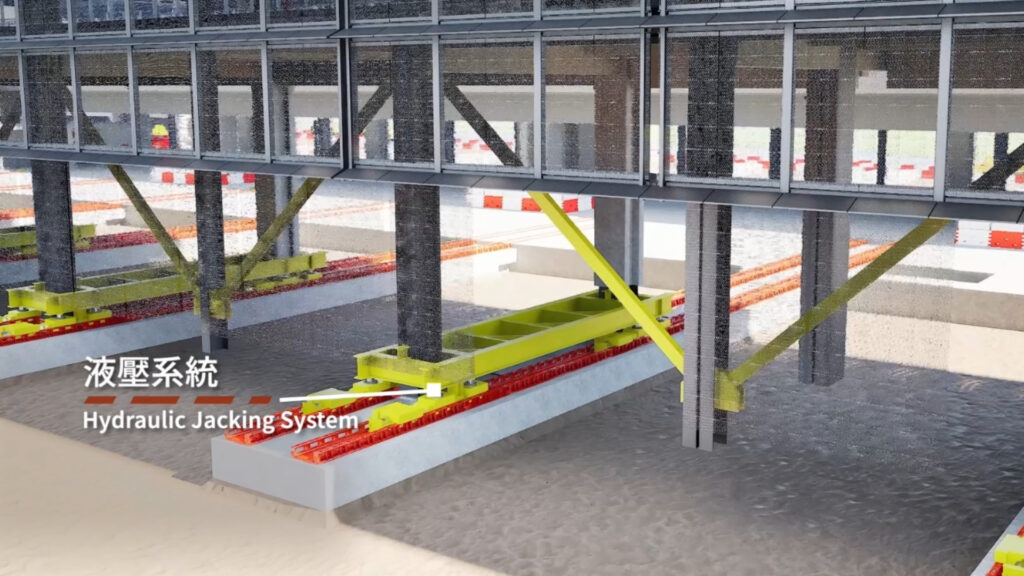
The station structures will be skidded using a hydraulic jacking system consisting of skidding rails, hydraulic jacks and monitoring sensors. Continuous monitoring will be conducted throughout the process to ensure both precise and accurate integration with the foundations.
The station structures will be skidded using a hydraulic jacking system consisting of skidding rails, hydraulic jacks and monitoring sensors. Continuous monitoring will be conducted throughout the process to ensure both precise and accurate integration with the foundations.
The Most Critical Stage – Final Skidding and Connection to the Tuen Ma Line
The large-scale skidding operations are scheduled to take place in 2027. It is planned to carry out the skidding for the station structures alongside the downtrack of the Tuen Ma Line (towards Wu Kai Sha) late in the first quarter of 2027, while the skidding along the uptrack (towards Tuen Mun), which is on the opposite side, is scheduled for the third quarter of 2027. The station structures on one side will be gradually skidded from a position approximately 30 metres away towards the viaduct. The final and most critical stage will be connecting the station structures to the Tuen Ma Line.
| Key Procedures for Skidding and Connection with the Tuen Ma Line |
| Skidding the station structures to connect to the Tuen Ma Line |
| Overhead line migration |
| Removal of overhead line masts and parapets |
| Installation of platform slabs |
| Installation of temporary hoarding to separate the new station and the operating line |
| Train testing and inspections |
Owing to the complexity of the works and the interface with the Tuen Ma Line, the above activities must be carried out continuously to ensure the safe resumption of train operations after the new station structures have been installed. As a result, the two station-sliding operations will need to extend into daytime operating hours. Services at a few stations on the Tuen Ma Line are expected to be affected during the works. Detailed service impact assessments are underway, and MTR will announce the specific arrangements in due course.
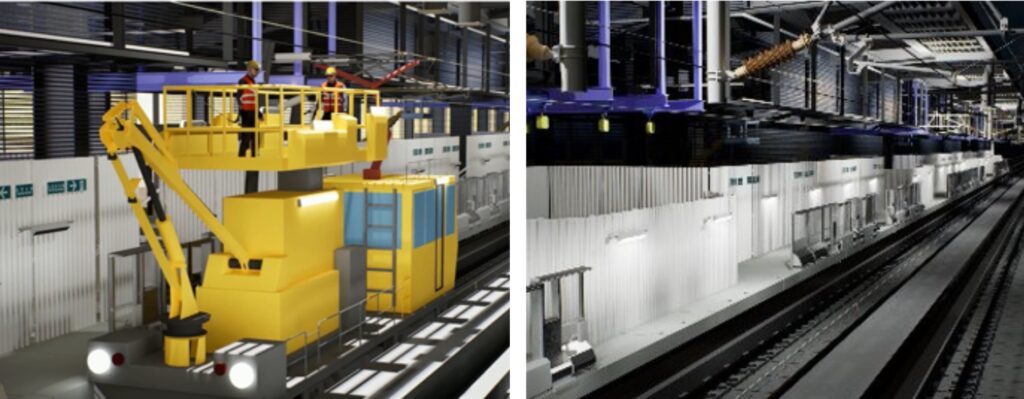
Left: Overhead line migration and removal of overhead line masts; Right: Installation of temporary hoarding and conduction of final tests and checks before resumption of train services
A Solution Balancing Railway Operations, Risk Management and on Works Safety
The adoption of skidding construction greatly reduces construction works on the Tuen Ma Line, which effectively manages and reduces the safety risks associated with frequent works near or on an operating viaduct. The team is working extensively on the construction details and arrangements, while also carrying out testing and trials, and is making every effort to ensure readiness for this mega skidding operations in 2027. Following completion of the skidding works, subsequent works such as installation of the remaining E&M systems and facilities, and system integration and testing will follow, with the overall HSK Station project scheduled for completion in 2030.